2014-03-06

Focusrite Scarlett 2i4 RMAA test report (Balanced I/O).

Below is a RightMark Audio Analyzer (RMAA) test results of the balanced I/Os of the Focusrite Scarlett 2i4 USB sound card.
See also the early posts about viscera and unbalanced I/O tests of the Scarlett 2i4.


Abbreviations and conditions:
  1. S1 - mono; instrumental + pad mode at 11 clock gain; 3 clock monitor volume; 220 ms latency; ASIO;
  2. S2 - stereo; instrumental + pad mode at 11 clock gain; 3 clock monitor volume; 220 ms latency; ASIO;
  3. S3 - stereo; instrumental + pad mode at 11 clock gain; 3 clock monitor volume; 220 ms latency; MME (16-bit @ 96 kHz);
  4. S4 - stereo; instrumental mode at 11 clock gain; 1 clock monitor volume; 220 ms latency; ASIO;
  5. S5 - stereo; line mode at 1 clock gain; max monitor volume; 220 ms latency; ASIO;
  • Windows 7 x64;
  • Focusrite USB2.0 Win-2.5.1 Driver;
  • ASIO 24-bit @ 96 kHz;
  • MME 16-bit @ 96 kHz (only 16-bit by Focusrite MME driver supported);
  • RMAA 6.3.0;
  • Balanced TRS jack cable - #1 output to #1 input, #2 output to #2 input;

Test results


S1 - THD


S2 - THD
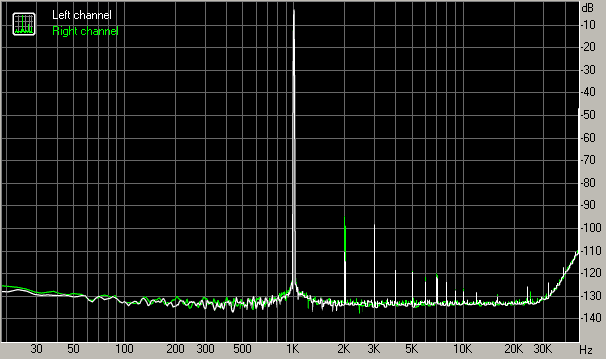

S2 - Stereo crosstalk


S2 - Dynamic range


S2 - IMD

2014-01-24

Focusrite Scarlett 2i4 RMAA test report.

Below is a RightMark Audio Analyzer (RMAA) test results of the "2 in / 4 out USB audio interface for musicians and digital DJs...".
See also a new post about balanced I/O tests of the Scarlett 2i4.


Abbreviations and conditions:
  1. S2i4-l - unbalanced #3 and #4 outputs looped to #1 and #2 inputs in the line mode with TS jacks; ~70% gain; 40 ms latency; stereo;
  2. S2i4-lm - unbalanced #3 output looped to #1 input in the line mode with TS jack; ~70% gain; 40 ms latency; mono;
  3. S2i4-lp - unbalanced #3 and #4 outputs looped to #1 and #2 inputs in the line + pad mode with TS jacks; ~80% gain; 220 ms latency; stereo;
  4. S2i4-lpm - unbalanced #3 output looped to #1 input in the line + pad mode with TS jack; ~80% gain; 220 ms latency; mono;
  5. S2i4-ip - unbalanced #3 and #4 outputs looped to #1 and #2 inputs in the instrument + pad mode with TS jacks; ~55% gain; 220 ms latency; stereo;
  6. S2i4-ipm - unbalanced #3 output looped to #1 input in the instrument + pad mode with TS jack; ~55% gain; 220 ms latency; mono;
  7. S2i4-bipm - balanced #1 output by ~80% monitor volume pot looped to #1 input in the instrument + pad mode with TRS jacks; ~40% gain; 220 ms latency; mono;


Test results


S2i4-l frequency response


S2i4-l dynamic range


S2i4-l THD


S2i4-lp and S2i4-lpm frequency response


S2i4-lp and S2i4-lpm dynamic range


S2i4-lp and S2i4-lpm THD


S2i4-lp and S2i4-lpm IMD


S2i4-lp stereo crosstalk


S2i4-ip and S2i4-bipm frequency response


S2i4-ip and S2i4-bipm noise level


S2i4-ip and S2i4-bipm dynamic range


S2i4-ip and S2i4-bipm THD


S2i4-ip and S2i4-bipm IMD


S2i4-ip stereo crosstalk

2013-12-11

foobar2000 WASAPI output RMAA test report

This is a comparison test between WASAPI and standard playback output of the foobar2000 audio player.


Test conditions:
  • Windows 7 Pro SP1 x64.
  • RightMark Audio Analyzer 6.3.0 (RMAA).
  • foobar2000 v1.2.9 (fb2k) with resampling to 96kHz by PPHS plug-in.
  • 16bit/44100Hz audio PCM file.
  • WASAPI output with 24bit setting of fb2k component.
  • MME API output with 100% of volume level and with 24bit/96kHz settings of Windows mixer.
  • Input loop of "What U Hear" (WUH) driver of the Creative Sound Blaster X-Fi HD (Digital Music Premium HD) USB sound card with 24bit/96kHz settings.


As you can see the results below, there is no differences. I'm sure that is because of absence of the resampling process by OS due to using of PPHS in according with Windows playback settings. Maybe it would make sense to use an WASAPI component for the fb2k without PPHS plug-in, to bypass a bad- quality resampling of the operating system, if a sound card supports a different sampling frequencies at hardware level (not a X-Fi HD case).

Testing chain: fb2k MME output -> WUH input:
  1. Frequency response (from 40 Hz to 15 kHz), dB : +0.00, -0.00
  2. Noise level, dB (A) : -100.5
  3. Dynamic range, dB (A) : 98.8
  4. THD, % : 0.0004
  5. THD + Noise, dB (A) : -92.9
  6. IMD + Noise, % : 0.0031
  7. Stereo crosstalk, dB : -99.2
  8. IMD at 10 kHz, % : 0.0033

Testing chain: fb2k WASAPI output -> WUH input:
  1. Frequency response (from 40 Hz to 15 kHz), dB : +0.00, -0.00
  2. Noise level, dB (A) : -100.5
  3. Dynamic range, dB (A) : 98.8
  4. THD, % : 0.0004
  5. THD + Noise, dB (A) : -92.9
  6. IMD + Noise, % : 0.0031
  7. Stereo crosstalk, dB : -99.2
  8. IMD at 10 kHz, % : 0.0033

Frequency response


Noise level


Dynamic range


THD + Noise (at -3 dB FS)


Intermodulation distortion


Stereo crosstalk


IMD swept tones


Frequency response swept sine


fb2k - foobar2000 MME output tests.
fb2kWASAPI - foobar2000 WASAPI output tests.

2013-11-02

Creative Sound Blaster X-Fi HD Sound Card - RMAA test report @24bit/96kHz

This is a line output to line input wire loop RMAA test of Creative Sound Blaster X-Fi HD (Digital Music Premium HD) at 24bit/96kHz. Tests have made without resampling by Windows 7 (x64) drivers by setting it to 24bit/96kHz.


Testing chain: line output (24bit/96kHz.) -> line input (24bit/96kHz.):
  1. Frequency response (from 40 Hz to 15 kHz), dB : +0.01, -0.07
  2. Noise level, dB (A) : -101.8
  3. Dynamic range, dB (A) : 101.8
  4. THD, % : 0.0030
  5. THD + Noise, dB (A) : -87.1
  6. IMD + Noise, % : 0.0042
  7. Stereo crosstalk, dB : -96.2
  8. IMD at 10 kHz, % : 0.0064


Frequency response


Noise level


Dynamic range


THD + Noise (at -3 dB FS)


Intermodulation distortion


Stereo crosstalk


IMD (swept tones)


P.S.
See this link for a line output to line input loop RMAA test at 24bit/48kHz.
Tests of MME output and of WASAPI Exclusive (Win Sound) output are identical - see this link is the 16-bit @ 44.1 kHz playback test.

2013-10-31

Creative Sound Blaster X-Fi HD Sound Card - RMAA test report of "What U Hear" input @24bit/96kHz

This is a MME API output to "What U Hear" input loop RMAA test of Creative Sound Blaster X-Fi HD (Digital Music Premium HD) at 24bit/96kHz. Tests have made without resampling by Windows 7 drivers by setting it to 24bit/96kHz.


Testing chain: MME output (24bit/96kHz.) -> "What U Hear" input (24bit/96kHz.):
  1. Frequency response (from 40 Hz to 15 kHz), dB : +0.00, -0.00
  2. Noise level, dB (A) : -149.4
  3. Dynamic range, dB (A) : 133.2
  4. THD, % : 0.0000
  5. THD + Noise, dB (A) : -128.1
  6. IMD + Noise, % : 0.0002
  7. Stereo crosstalk, dB : -148.5
  8. IMD at 10 kHz, % : 0.0000


Frequency response


Noise level


Dynamic range


THD + Noise (at -3 dB FS)


Intermodulation distortion


Stereo crosstalk


IMD (swept tones)


P.S.
See this link is a line output to line input loop RMAA test at 24bit/48kHz.

2013-09-30

Focusrite Scarlett 2i4 inside.

Focusrite Scarlett 2i4 (1 gen) is a 2 in / 4 out USB audio interface featuring:
  • Two High Quality Microphone/Instrument/Line award-winning Focusrite Preamps.
  • Four High Quality Outputs.
  • MIDI I/O.
  • USB bus powered.
  • Rugged Metal Unibody Case.
  • Unique Signal Halos.
  • Direct Monitor Function.
  • Included software for Mac and PC.
  • WDM and ASIO drivers (24-bit by ASIO).


See RMAA tests here.

Chips:
  • XMOS XS1-L01A-TQ128-C5 (GT1244L1 C5 PKH293.09) - Microcontroller (500MIPS, 32BIT, 64KB SRAM).
  • Cirrus Logic CS4272-CZZ YFAABXNJ1238 - 114 dB, 24-Bit, 192 kHz Stereo Codec.
  • AKM 4384ET 6R230 - 106dB 192kHz 24-Bit 2ch DAC.
  • JRC 4565 C096F - DUAL OPERATIONAL AMPLIFIER.
  • JRC 2122 C109H - ULTRA LOW NOISE DUAL OPERATIONAL AMPLIFIER.
  • ATMEL AT25DF041A ATMEL1113 - Serial interface flash memory device.
  • Texas Instruments TI HC4066 2BAQDCK G4 - Quadruple Bilateral Analog Switches.
  • SMSC USB3343 1511900 - Hi-Speed USB 2.0 Transceiver Family Featuring RapidCharge.
  • CN PC900V - Photocoupler.
  • 7519A G2KSZ
  • C1L95 Y72


My Pablo Picasso - Nude, Green Leaves and Bust